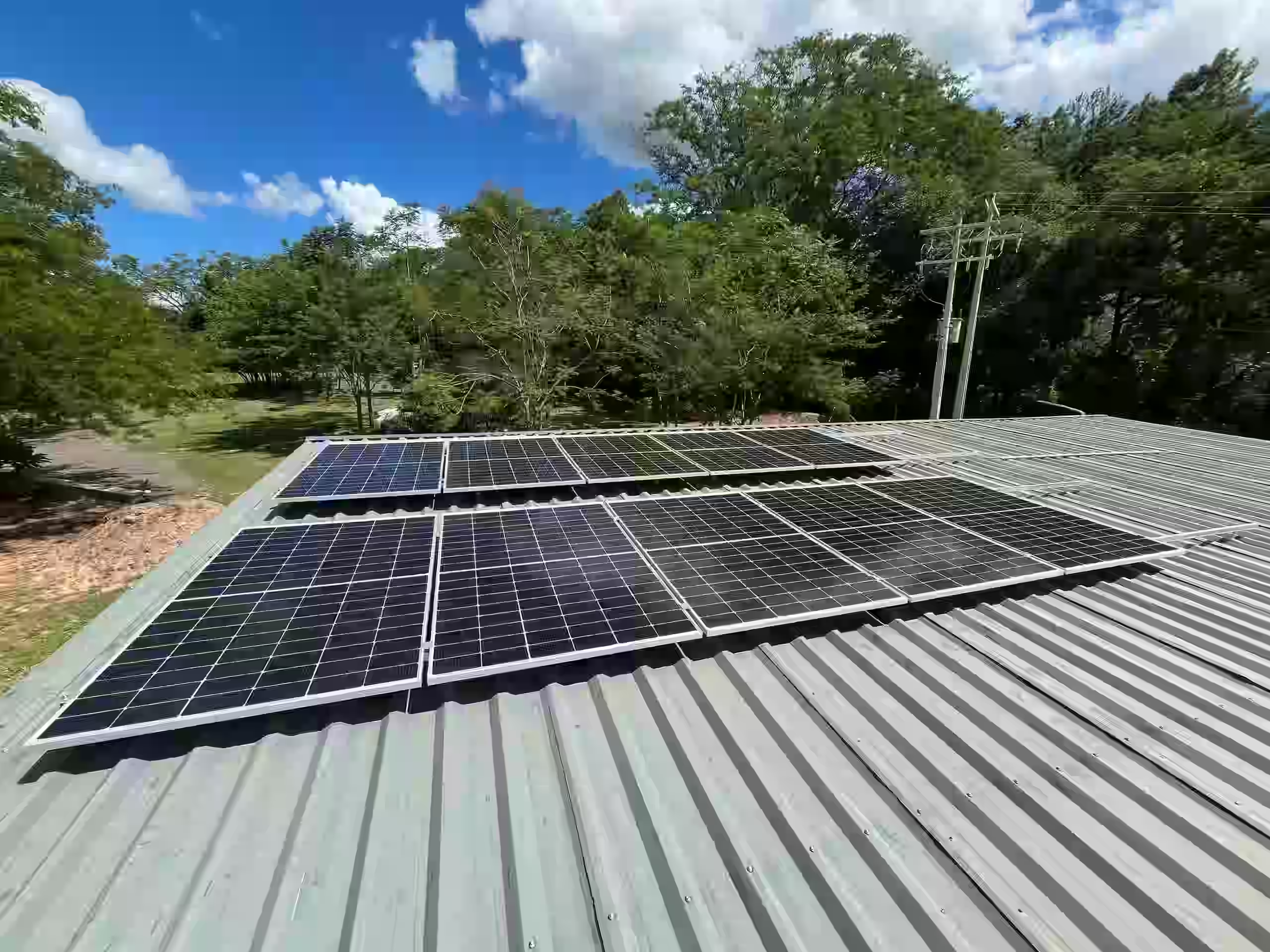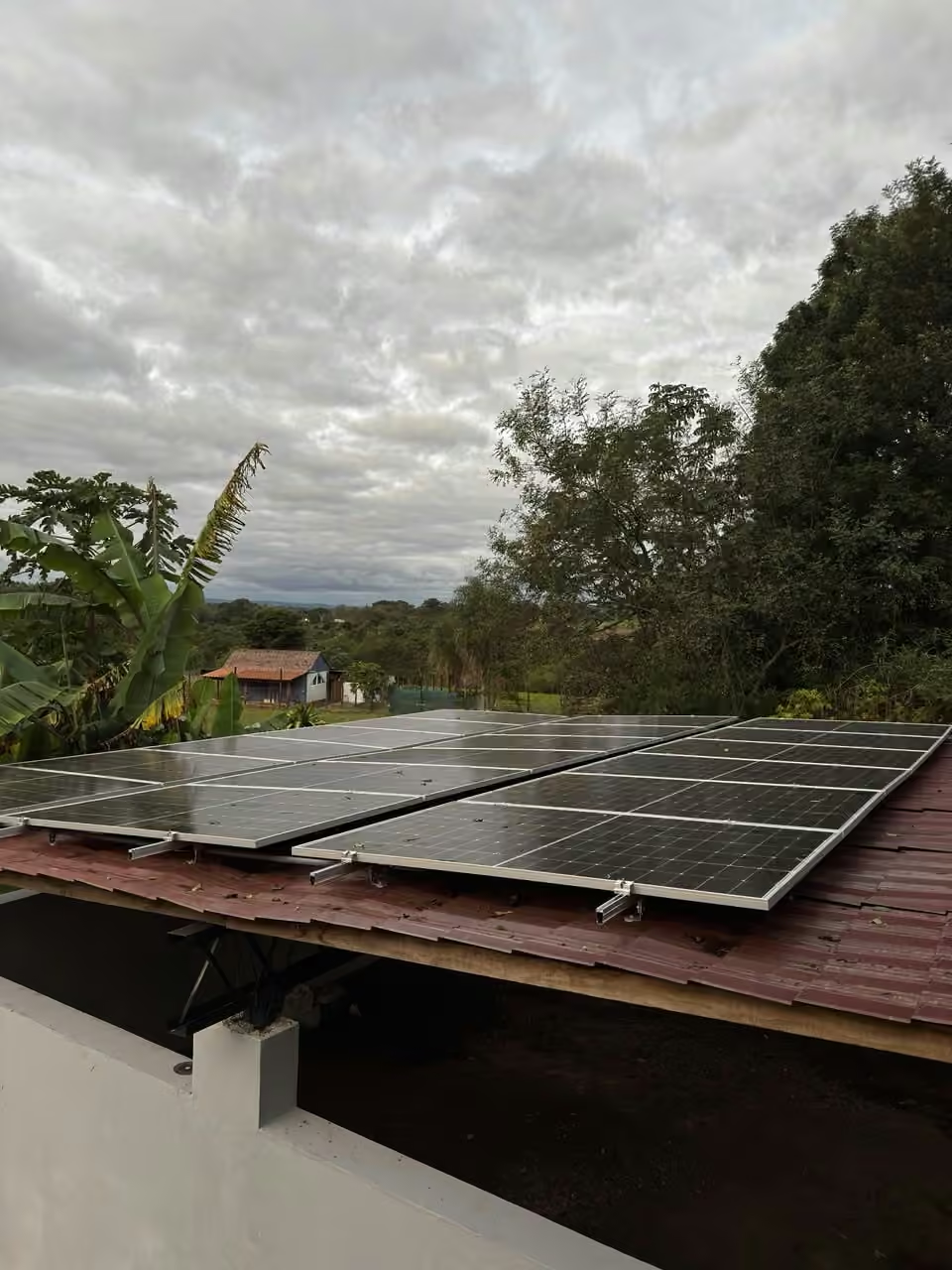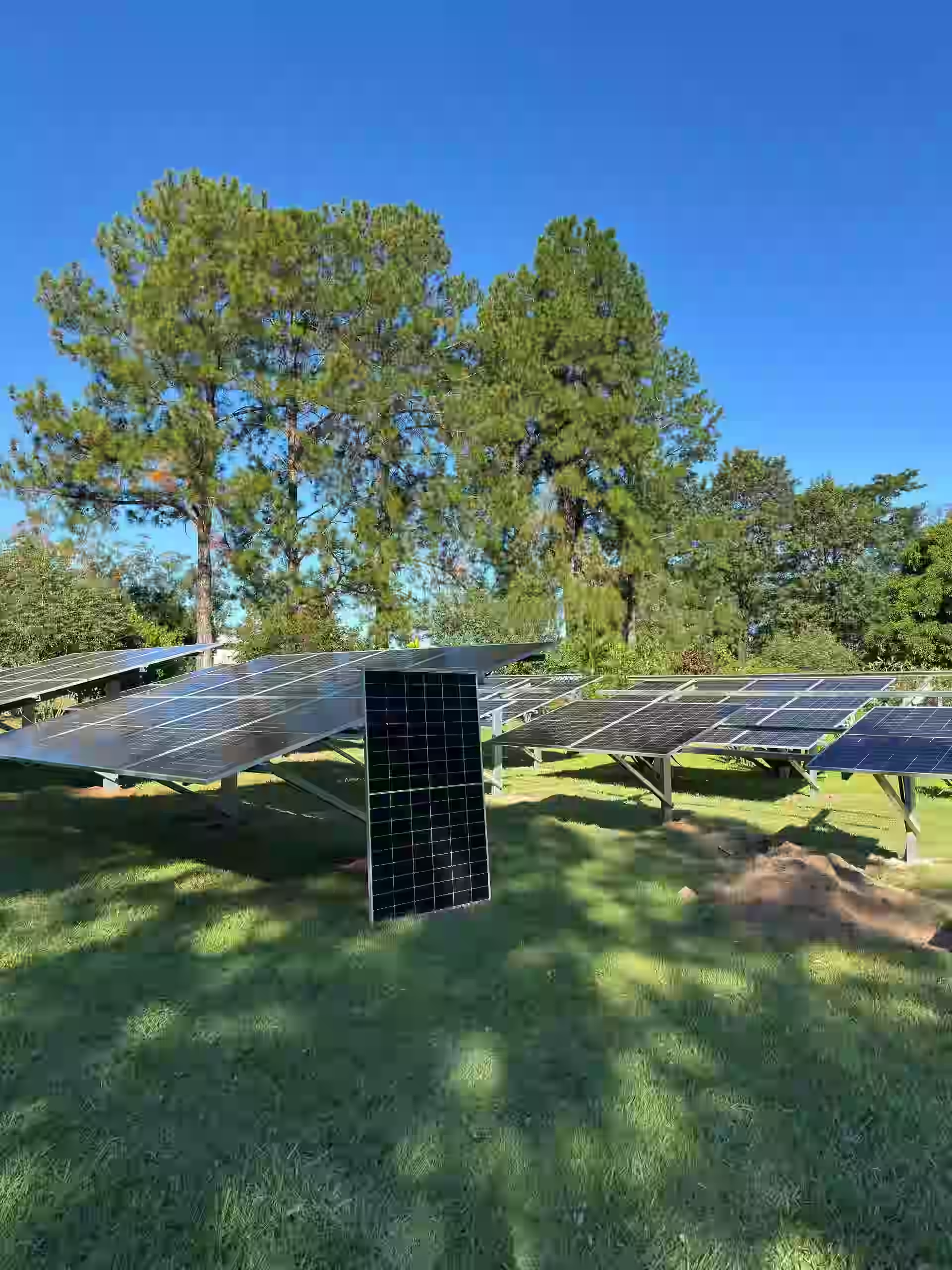
When a property’s electricity consumption exceeds what a typical residential system can cover — whether due to agricultural activity, a growing business, or a home with high energy demand — the solution isn’t simply “add more panels to the roof.” At Guaira-Solar, we just completed a large-scale project in Independencia, Guairá: a ground-mounted solar plant on an elevated structure, made up of 56 solar panels distributed across 7 independent supports, two 12 kW inverters working in a master/slave configuration, and a lithium battery bank made up of 6 units of 5 kW each.
Why install on the ground instead of the roof?
When a project grows to this scale, mounting the panels on an elevated ground structure — rather than the home’s roof or a carport — stops being a secondary option and becomes the most logical decision:
- Optimal orientation and tilt: unlike an existing roof, a ground structure is designed from scratch with the ideal angle to maximize solar capture year-round.
- No roof space limitations: projects of this size (56 panels) often simply don’t fit on the available surface of a residential roof.
- Better panel ventilation: being elevated and separated from the ground, the modules stay cooler, which slightly improves their efficiency on the hottest days of the Paraguayan summer.
- More accessible maintenance: cleaning, inspection, and eventual component replacement are considerably simpler than working at height on a roof.
- Future expansion potential: a modular ground structure, like the 7 supports used in this project, allows adding more supports and panels later without redesigning the entire system.
System specifications
This project combines components suited for electrical demand considerably higher than an average household:
- 56 solar panels, distributed across 7 independent elevated support structures on the ground
- 2 inverters of 12 kW each (24 kW total), configured in master/slave mode
- 6 LiFePO4 lithium batteries of 5 kW each, totaling a 30 kW storage bank
What does it mean for one inverter to work in “master” mode and the other in “slave” mode?
This is one of the most interesting — and least known outside technical circles — configurations of this project. When the required power exceeds the capacity of a single inverter, instead of installing one oversized unit, two (or more) inverters are combined working in parallel:
- The master inverter acts as the system’s “brain”: it synchronizes with the electrical grid, coordinates the battery bank’s operation, and makes switching decisions in the event of a power outage.
- The slave inverter follows the master’s instructions, adding extra power capacity without duplicating the control logic.
This configuration allows scaling the system’s total power (in this case, to a combined 24 kW) without depending on a single large inverter, and also offers a level of redundancy: in the event of a failure in one of the units, partial operation can be maintained with the other.
A 30 kW battery bank: what’s all that storage capacity for?
With 6 lithium batteries of 5 kW each, this system isn’t designed solely to cover a brief ANDE power outage, but to sustain considerable consumption over longer periods without relying on the grid:
- Continuous operation of agricultural equipment, irrigation pumps, or machinery for several hours
- Full coverage of nighttime consumption on properties with high electrical demand
- Greater real energy autonomy — not just as emergency backup, but as an active part of the property’s daily energy strategy
What type of properties make sense for a system of this scale?
A ground-mounted solar plant with this configuration is especially suited for:
- Agricultural or livestock properties with irrigation pumps, refrigeration systems, or electrical machinery
- Businesses or small industries with high and constant electricity consumption
- Large homes with multiple air conditioning systems, a pool, or several housing units
- Large plots of land where available roof space is insufficient for the number of panels needed
The design process: it’s not just about “more panels”
A system of this complexity requires careful sizing from the start:
- Analysis of the property’s actual consumption, including demand peaks from machinery or heavy equipment
- Design of the support structure, calculating the number of supports needed (in this case, 7) based on the terrain layout and solar orientation
- Sizing of inverter power, deciding whether a single large inverter or a master/slave configuration like this one makes more sense
- Calculation of the battery capacity needed based on desired hours of autonomy, not just as backup during outages
Frequently asked questions
Why use two 12 kW inverters instead of one single 24 kW unit?
The master/slave configuration allows scaling power modularly, offers redundancy against failures, and in many cases proves more practical to install and maintain than a single large unit.
Is a ground structure (elevated mounting) more expensive than installing on the roof?
It generally involves an additional investment in the support structure, but it allows achieving optimal orientation and overcoming roof space limitations, which can translate into better long-term performance.
Does the 30 kW of battery storage leave me completely off the grid?
It depends on the property’s daily consumption. For high or continuous consumption, this battery bank provides several hours of real autonomy, though full grid independence depends on the specific sizing relative to consumption.
Can this system be expanded in the future?
Yes. Both the modular support structure and the parallel inverter configuration are designed to allow adding more panels, supports, or even another inverter in slave mode later on.
Does your property need a solar system at this scale?
At Guaira-Solar, we’re a German family business based in Independencia, Guairá, specializing in residential, agricultural, and commercial solar systems of all sizes, including large-scale ground plants like this one. Contact us for a technical assessment of your property and custom sizing based on your actual consumption.